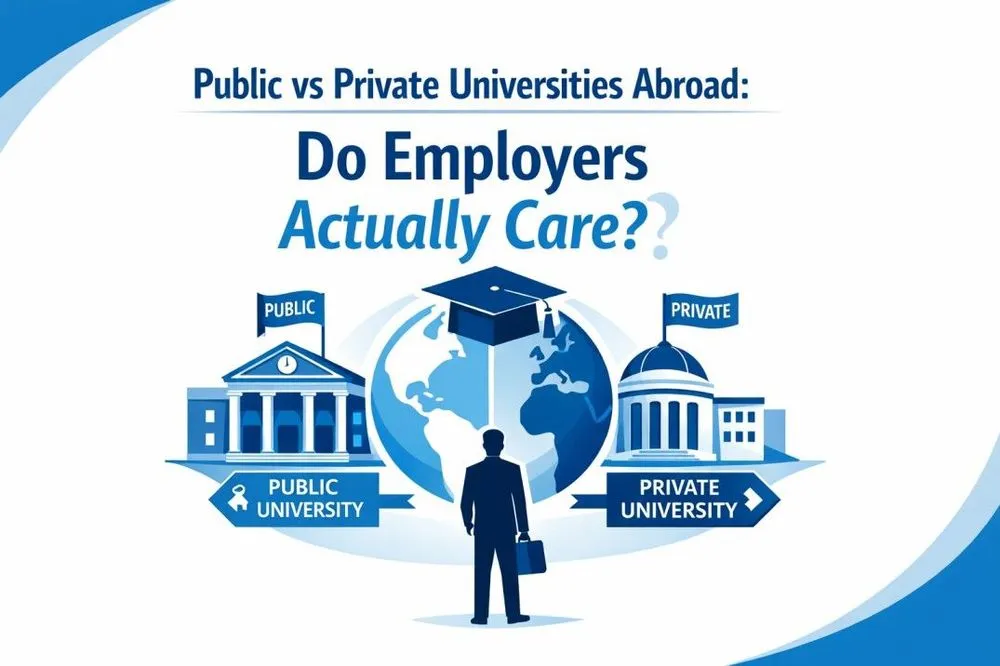
Choosing a university is a major life decision. You might wonder if a private school degree carries more weight.
Or you might worry that a public university is too large to be noticed.
The truth is simpler than you think.
Employers care about what you learned and what you can do. Not whether your university is public or private.
That's it. The funding model doesn't matter. What matters is your skills, your experience, and your ability to do the job.
KEY HIGHLIGHTS:
Employers in 2026 do not choose candidates based on whether their school is public or private.
The reputation of your specific study program matters more than the funding of the university.
Public universities are the best choice if you want to avoid high debt.
Private schools often have very active alumni networks that can help with job referrals.
How Employers View Public vs. Private Universities?
Employers abroad focus on what you can do. They care about your ability to solve problems and look for clear evidence of your expertise.
This is why many students decide to change university if they feel their current program isn’t helping them build practical, job-ready skills.
What Do They Care About?
Program Quality: They care about how good your program is and what you actually learned from it.
Your Skills: Your skills matter because they show what you can do in real situations.
Your Experience: Your experience, such as internships, projects, or work, proves you can use your knowledge.
Your GPA/Results: Your GPA or results show your effort and understanding.
Your Network: Your network matters because good connections often mean better exposure and opportunities.
What Don't They Care About?
University Funding: They don’t care whether your university is funded by the government or by tuition fees.
Campus Size: They don’t care if your campus is big or small.
Public or Private: They don’t care whether your university is public or private.
University Labels: They don’t care about the name, status, or labels of the institution as much as your abilities.
Administrative Details: They don’t care about internal university systems or structures that do not affect your skills or performance.
Key Differences in Public vs. Private University
The real differences between public and private universities:
Public Universities
Public universities are funded by the government, which makes their tuition lower and sometimes free.
They usually have large campuses, bigger class sizes, and many different programs to choose from. Because there are so many students, professors may have less time for individual attention, especially in the early years.
Public universities also have very large and diverse alumni networks spread across many industries.
Private Universities
Private universities rely mainly on tuition fees, donations, and endowments, so tuition is usually higher. While your academic score still matters, these universities often look more closely at your overall profile, including motivation, skills, and background.
They tend to have smaller campuses and smaller classes, which allows professors to give more personal attention and mentorship.
Private universities often focus on specific or specialized programs rather than offering everything. Their alumni networks are smaller but usually closer and more connected.
When University Choice Matters Most?
Your university choice matters for you, not for employers. Here's when it matters:
Budget Matters: If cost is a problem, public universities are cheaper or sometimes free (Germany, Norway). This lets you graduate without debt.
Learning Style Matters: If you want small classes and direct mentoring, private universities often offer that. If you like big campus life and lots of program choices, public universities often provide that.
Program Reputation Matters: The specific program you choose matters more than the funding model. A top engineering program at a public university will open more doors than an average engineering program at a private university.
Location Matters: A well-known local public university might have stronger connections with employers in that region. A private university far away might not.
How to Choose University?
Your decision should be based on your personal needs. Do not choose based on a myth about "private being better."
Stop Asking:
- Should I go Public or Private
Start Asking:
- Can I afford it?
- What Program am I Interested In?
- How do I learn best?
- Where do I want to work?
- Can I build skills and experience?
What Actually Matters to Employers in 2026?
In 2026, the job market has shifted away from traditional labels. A degree or a job title is no longer enough to land a top role.
Employers now look for a specific blend of technical ability and human instinct.
Smart Use of AI: Use AI wisely, check results, and apply your own judgment.
Human Skills: Creativity, empathy, and problem-solving matter more than ever.
Adaptability: Keep learning and stay flexible as technology changes fast.
Commitment & Fit: Be reliable, align with company values, and support your team.
Conclusion
Employers abroad do not prioritize the funding model of your university. They prioritize your talent and your training. A high GPA and a strong portfolio will open doors regardless of your school's "public" or "private" status.
Focus on choosing a program that fits your budget and learning style. Focus on gaining practical skills. Your ability to demonstrate your value is what will ultimately get you hired.
Frequently Asked Questions
Does a private university degree guarantee a higher salary?
No. Salary is determined by your role, your industry, and your skills. While some elite private schools have high-earning graduates, many public university graduates earn just as much in fields like tech and engineering.
Are public universities less prestigious than private ones?
Not necessarily. Many of the world’s top-ranked universities are public. For example, the University of California, Berkeley, and the University of Oxford are public institutions with global prestige.
Should I choose a private school for networking?
Private schools often have smaller, more tight-knit alumni networks. This can be helpful. However, large public universities have massive alumni bases across many different industries. Both offer networking value in different ways.
What is the most important thing on a resume for 2026?
Practical experience and specific skills. Employers want to see that you can use the tools of your trade. Internships, certifications, and a strong portfolio are the most important elements.