You have the acceptance letter. You have the excitement. But you do not have the visa yet.
Getting into a university is difficult, but securing the visa is often the harder challenge. A single error on your application form can result in an immediate rejection. This forces you to defer your studies or lose your scholarship.
Immigration officers review thousands of applications. They look for specific reasons to say "no." Your job is to make it easy for them to say "yes."
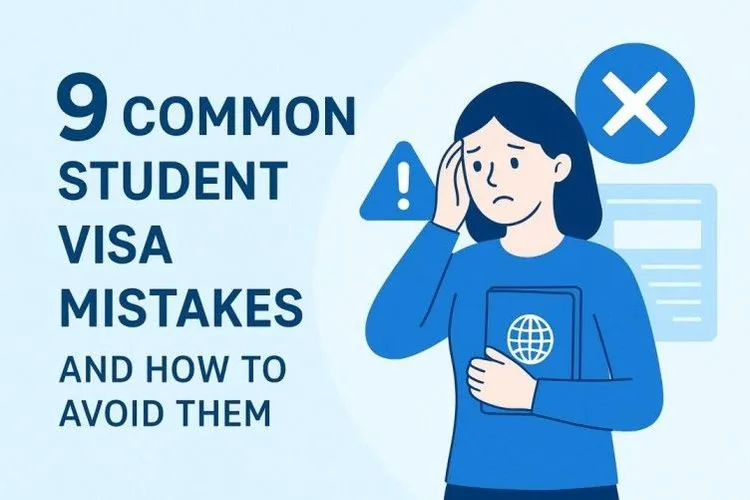
Here are the top 9 mistakes to avoid when applying for a student visa and how to fix them.
1. Insufficient or Unclear Financial Proof
This is the number one reason for visa rejection globally. Universities offer admission based on academic potential. Embassies grant visas based on financial security.
It is not enough to just "have" the money. You must prove the money is yours, it is accessible, and it is stable.
The Mistake
Last-minute deposits: Borrowing a large sum of money and depositing it into your account one week before applying. This looks suspicious to visa officers.
Unclear sponsorship: Using a distant relative (like a third cousin) as a sponsor without a logical explanation.
Ignoring living costs: Showing only enough money for tuition but forgetting the required amount for food, rent, and insurance.
How to Fix It
Show "Liquid" Assets
Immigration officers prefer liquid cash. This includes savings accounts, checking accounts, or fixed deposits that have matured. Avoid relying solely on property, gold, or stocks, as these are harder to liquidate quickly. Maintain a History
Most countries (especially the UK, Canada, and Australia) require a bank statement history of 3 to 6 months. The balance should be consistent. If there is a sudden large deposit, you must provide a "Source of Funds" document explaining where it came from (e.g., sale of land, bonus, loan).
Action Plan:
- Calculate Total Cost: Tuition + 1 Year Living Expenses + Travel Costs.
- Hold the Funds: Keep this amount in the bank for at least 28 days to 6 months before applying (depending on the country).
- Affidavit of Support: If your parents are paying, get a notarized legal document stating they agree to support you.
This sets a strong foundation for your application.
2. Writing a Vague Statement of Purpose (SOP)
Your Statement of Purpose (also called a Letter of Explanation) is the only place where you can speak directly to the visa officer. Many students copy templates from the internet. This is a fatal error.
The Mistake
- Generic goals: Writing sentences like "I love England because it is beautiful" or "I want to study management to be a manager."
- No career logic: Failing to explain how this specific degree helps your future career in your home country.
- Ignoring gaps: Not explaining why you took a two-year break after high school or college.
How to Fix It
Be Specific
Mention specific modules in the course. Mention the professors you want to learn from. Connect the course directly to a job title you want in your home country.
Address the Gaps
If you have a study gap, explain it. Did you work? Did you travel? Did you have a medical issue? Honesty is better than silence. A gap without an explanation looks like you were doing nothing or working illegally.
The "Why Us" Factor
Explain why you cannot do this course in your home country. If a similar course is available locally for cheaper, why are you spending thousands to go abroad? You need a valid academic reason.
SOP Structure Strategy:
- Paragraph 1: Who you are and what you want to study.
- Paragraph 2: Your academic background and why it fits this course.
- Paragraph 3: Why this specific university and country.
- Paragraph 4: Your future career plans (back home).
- Paragraph 5: Financial ability and conclusion.
A strong SOP can often save a weak profile.
3. Lack of "Ties to Home Country"
Student visas are "non-immigrant" visas. This means the visa officer must be convinced that you will return home after your studies. If they suspect you plan to stay illegally, they will reject you.
The Mistake
** Looking like an immigrant:** Expressing a strong desire to live, work, and settle permanently in the destination country immediately.
No assets at home: Having no family, property, or job prospects in your home country.
How to Fix It
Focus on the Return
Your application must show that your primary goal is education, not migration. Even if the country allows post-study work permits (like Canada or the UK), your visa application intent must be study-focused.
Evidence of Ties
Family: Evidence of immediate family (parents, siblings) remaining in your home country.
Economic: Property deeds, investments, or a letter from a current employer offering you a job upon return.
Social: Memberships in community groups or societies in your home country.
Tip: During an interview, if asked "Do you want to stay in the US/UK after graduation?", a safe answer is: "My focus is on my education. After graduation, I intend to return home to apply these skills, but I would like to use the post-study work opportunity to gain some international exposure first if eligible."
This balance shows ambition without violating visa intent.
4. Inconsistent Documentation
Visa officers are trained to spot discrepancies. If your passport says one thing and your birth certificate says another, it raises a red flag.
The Mistake
Name Mismatches: Spelling your name "Jon" on the application but "John" on school transcripts.
Date Errors: Incorrect birth dates or graduation dates.
Untranslated Documents: Submitting local language documents without a certified English translation.
How to Fix It
The "Eye-for-Detail" Review
Place all your documents on a table. Check every name, date, and passport number. They must match exactly.
Translation Protocol
If a document is not in English, do not translate it yourself. Use a certified translator. Submit both the original copy and the translated copy together.
Checklist:
- Passport (valid for at least 6 months beyond your stay).
- Admission Letter (CAS/I-20/COE).
- Academic Transcripts.
- Standardized Test Scores (IELTS/TOEFL/GRE).
- Passport-sized photos (specific dimensions required).
Small details show you are serious and organized.
5. Choosing an Irrelevant Course
This is known as the "Academic Progression" rule. Your chosen course must make sense based on your history.
The Mistake
Random Field Change: You have a Bachelor’s in History, but you apply for a Master’s in Data Science without any work experience or bridge courses.
Lower Level Studies: Applying for a Diploma when you already hold a Master’s degree.
How to Fix It
Connect the Dots
If you are changing fields, you must explain why in your SOP. You need to show that you have taken short courses, done internships, or have work experience that prompted this change.
Logical Progression
The course should be an upgrade.
- High School → Bachelor’s.
- Bachelor’s → Master’s.
- Master’s → PhD or Specialized Research.
If you are doing a second Master’s, explain why the first one was not enough for your career goals.
This logic proves you are a genuine student.
6. Poor Interview Preparation
For countries like the USA, the visa interview is the deciding factor. For others, it might be a phone call. Nervousness can look like dishonesty.
The Mistake
Memorized Answers: Reciting a script like a robot. Officers hate this.
Not Knowing the Course: Unable to name the subjects you will study or the duration of the course.
Contradicting the Application: Saying your father pays for your fees when your application says your uncle.
How to Fix It
Know Your Details
You should know the university location, the annual tuition fee, your sponsor's job title, and your accommodation plans.
Mock Interviews
Practice with a friend. Focus on speaking naturally. It is okay to pause and think. It is okay to ask the officer to repeat the question.
Common Questions to Master:
- Why did you choose this university?
- Who is sponsoring you?
- What do your parents do?
- Why not study in your home country?
Confidence comes from knowledge, not memorization.
7. Late Application Submission
Timing is everything. Applying too late puts unnecessary pressure on the embassy and yourself.
The Mistake
- Cutting it close: Applying 2 weeks before the course starts.
Ignoring processing times: Assuming the visa will take 15 days when the website says 6 weeks.
How to Fix It
The 3-Month Rule
Ideally, apply 3 months before your course start date. This allows time for:
- Biometrics appointments.
- Medical examinations.
- Additional document requests (if any).
- Passport courier delays.
Check Peak Seasons
July and August and November and December are peak times for student visas. Processing times double during these months. Apply early to beat the rush.
Being early shows you are responsible.
8. Ignoring Health and English Requirements
These are technical requirements, but they result in automatic rejection if missed.
The Mistake
Expired Test Scores: Using an IELTS/TOEFL score that is more than 2 years old.
Ignoring Sub-scores: Getting a high overall score but failing a specific section (e.g., getting 5.0 in Writing when the requirement is 6.0).
Medical Issues: Failing to get the required chest X-ray or TB test from an approved panel physician.
How to Fix It
Verify the Validity
Check your English test validity. If it expires before your visa appointment, retake the test.
Use Panel Physicians
Embassies have a specific list of approved doctors. A certificate from your family doctor will be rejected. Go to the official immigration website of the country and find the "Panel Physician" list for your city.
Tip: Wear glasses? Bring them to your medical exam. Have a past surgery? Bring the medical reports.
Clear medicals and test scores speed up the process.
9. Providing False or Misleading Information
This is the most dangerous mistake. It does not just lead to rejection; it can lead to a ban.
The Mistake
Fake Documents: Buying a fake bank statement or experience letter.
Hiding History: Clicking "No" on the question "Have you ever been refused a visa for any country?" when you actually have.
How to Fix It
Absolute Honesty
If you were rejected for a tourist visa 5 years ago, declare it. Immigration databases are shared between countries (especially the Five Eyes: US, UK, Canada, Australia, NZ). They will know.
Explain, Don't Hide
A previous rejection does not mean an automatic refusal now. Explain that your circumstances have changed since the last application.
Consequence:
Using fake documents leads to a 5-year or 10-year ban. It is never worth the risk.
Honesty builds trust with the officer.
Conclusion
Securing a student visa is the final bridge between your dream and reality. Many students view this process as a lottery. It is not. It is a logical, bureaucratic process based on rules, evidence, and credibility.
Most rejections happen because applicants focus too much on the university admission and too little on the immigration requirements. They assume the acceptance letter is enough. As we have discussed, it is only the beginning.
Avoid these mistakes to prove you are a genuine student. Check your documents and stay honest. With solid preparation, securing your visa is just the next step.
Frequently Asked Questions
Can I reapply immediately if my student visa is rejected?
Yes, you can. However, applying immediately with the exact same application usually leads to another rejection. You must first analyze the "Refusal Letter" to understand the specific reason for denial. You should only reapply once you have addressed that specific issue (e.g., adding more financial proof or rewriting your SOP).
Does a study gap affecting my chances of getting a visa?
Not necessarily. A gap in education is acceptable if it is explained correctly. If you have a 2-year gap, you must provide evidence of what you did during that time (work experience letters, internships, or medical certificates). Leaving a gap unexplained is a mistake; explaining it with evidence is acceptable.
Will my visa be rejected if I have a low GPA or low grades?
It depends. Visa officers generally respect the university's decision to accept you. If the university has offered you a place despite low grades, the visa officer usually accepts your academic capability. However, you must be able to explain why your grades were low and why you will perform better now during your interview or in your SOP.
Is the visa interview difficult?
It is not an interrogation; it is a verification. The officer wants to confirm three things: you are a genuine student, you can afford it, and you will return home. If you speak naturally and tell the truth, it is easy. If you memorize scripts or lie, it becomes difficult because the officer will drill down into details you cannot answer.
Can I use a loan for my financial proof?
Yes. Education loans are a very strong form of financial proof because banks verify your background before lending the money. This adds credibility to your application. Ensure you have the official "Loan Sanction Letter" from a recognized bank, not just a provisional offer.
Do I need to book my flight ticket before the visa comes?
No. Embassies actually advise against buying non-refundable tickets before your visa is approved. A flight booking is not a requirement for a student visa application. You only need to show you have the funds to buy a ticket, not the ticket itself.