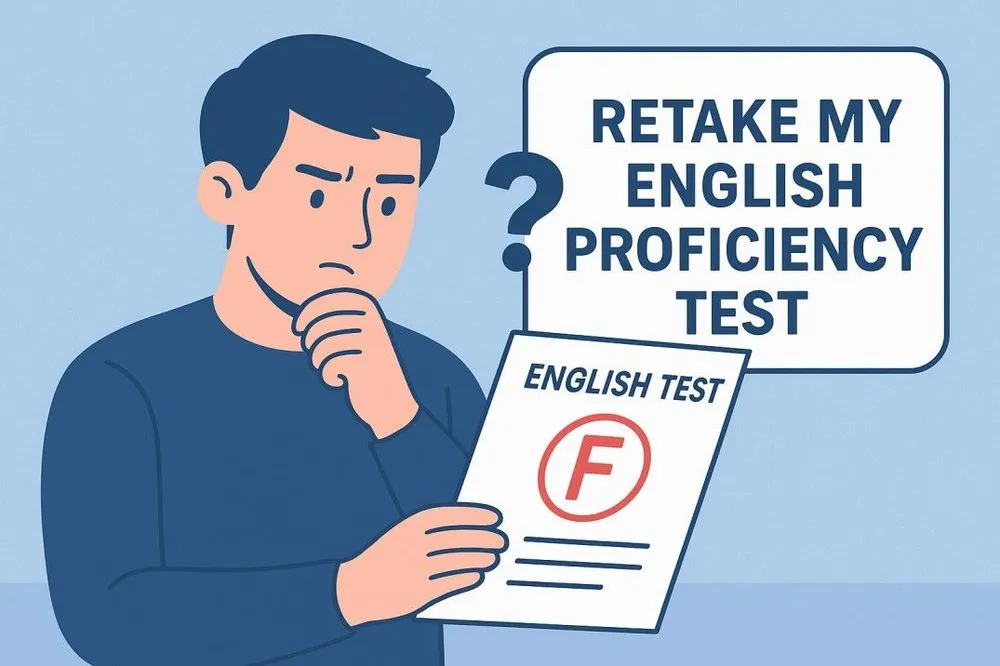
Receiving your English proficiency test scores can be a stressful moment. Maybe you missed your target by a single point. Maybe you passed the overall score but failed the writing section. Now you face a difficult choice.
Should you spend the money and time to retake the test?
The answer is not always yes. Retaking the test is sometimes a waste of resources. Other times it is the only way to save your application.
As we move into 2026, the landscape of English testing has shifted significantly. This updated guide helps you decide whether a retake is a strategic necessity or a waste of resources.
The 3 Critical Reasons to Retake Your Test Immediately
There are three specific situations where you have no choice. In these scenarios, a retake is not just a good idea. It is necessary.
1. You Missed the Strict Minimum Requirement
Universities and immigration departments use "cut-off" scores as a hard filter.
The "Sectional" Trap: Even with a high overall score, missing a sub-skill minimum (e.g., scoring 5.5 in Writing when 6.0 is required) will likely result in an automatic rejection.
New for 2026: If you take the TOEFL iBT on or after January 21, 2026, your score will be reported on a 1.0 to 6.0 band scale. Check if your target institution has updated its requirements to match this new CEFR-aligned scale.
2. Your Score Has Expired
English proficiency results generally remain valid for 2 years.
Australia Update: Effective August 7, 2025, some visa subclasses (like the 485 Temporary Graduate visa) require results issued within the last 12 months rather than 2 years.
Check the Date: If your certificate expires before your application is processed, you must retake the test to generate a valid, current result.
3. You Had a "Bad Day" (Unrepresentative Score)
If your score does not reflect your actual ability due to illness, testing center technical glitches, or severe anxiety, a quick retake is a smart move. Your skills are already at the target level; you simply need a fair environment to demonstrate them.
If you consistently score high in practice tests but tanked the real exam due to stress, a quick retake is a smart move. Your skills are already there. You just need a fair chance to show them.
Retaking for Competitiveness: Is Higher Always Better?
You might meet the minimum requirements. Is there still a reason to retake the test?
Yes. Meeting the minimum gets you in the door. Exceeding the minimum helps you stand out.
Impact on Scholarships and Immigration Points
Meeting the minimum gets you in the door; exceeding it gets you the funding or the visa invitation.
Canada (Express Entry): A jump from CLB 7 to CLB 9 continues to be the single biggest points-booster for many candidates.
Australia (Points Test): Under the August 2025 updates, "Superior English" (20 points) requires very high specific scores across all sections. For PTE, this often means hitting specific thresholds like 85+ in Writing and 88+ in Speaking.
Visa and Immigration Points
Immigration systems often use a points-based system. This is common in countries like Canada, Australia, and the UK.
Higher language scores often equal more points.
Example: In Canada’s Express Entry system, the difference between a CLB 7 and a CLB 9 (language benchmarks) creates a massive difference in your comprehensive ranking score.
If you are applying for permanent residency or a work visa, calculate your points. If a higher English score pushes you above the invitation threshold, you must retake the test. It is an investment in your future citizenship.
The "One Skill Retake" (OSR) Solution
This is a new development in the testing world. You may no longer need to sit through a full 3-hour exam to fix one low score.
Previously, if you failed the Writing section but aced the Listening, Reading, and Speaking, you had to retake the entire exam. You had to pay the full fee and risk getting a lower score in the sections you already passed.
How it Works
IELTS OSR: Available for computer-delivered tests. You can retake one section (Listening, Reading, Writing, or Speaking) within 60 days of your original test date.
TOEFL MyBest® Scores: TOEFL does not offer a single-skill retake, but they provide a "MyBest" score report that combines your highest section scores from all valid attempts in the last 2 years.
PTE Policy: As of 2025, PTE does not offer a one-skill retake. You must retake the full exam, and you are limited to 12 attempts within a 12-month window.
Important Warning: Not every university or government accepts the One Skill Retake. Always confirm with your institution's admissions office before booking a partial retake.
Verify Acceptance Before Booking
This is the most important warning. Not every institution accepts the One Skill Retake.
Some universities still require a "single sitting" score report. They want to see that you can perform well in all four skills on the same day. Before you pay for a partial retake, email the admissions office. Ask them explicitly: "Do you accept the IELTS One Skill Retake results?"
If they say no, you must retake the full exam.
When You Should NOT Retake the Test
There are times when booking a new test immediately is a mistake. It can lead to wasted money and further disappointment.
The "Large Gap" Reality Check
Be honest about your results. Is the gap between your current score and your target score small or large?
- Small Gap: 0.5 band difference (IELTS) or 5–10 points (TOEFL/PTE). A retake is a good idea.
- Large Gap: 1.5+ band difference (IELTS) or 20+ points (TOEFL/PTE).
If you need an IELTS 7.5 but scored a 6.0, a retake next week will not help. In the 2025 testing environment, scoring algorithms (especially in PTE and TOEFL) have become more sophisticated at detecting "memorized" patterns versus actual fluency.
You do not have a "testing" problem; you have a "proficiency" problem.
Your English level is currently not high enough to meet the threshold. Research from Cambridge and ETS suggests that it takes approximately 150–200 hours of guided study to move up one full IELTS band or 15–20 TOEFL points.
Retaking the test without months of dedicated study will likely result in a "plateau score"—the same result over and over. You cannot "luck" your way into a significantly higher band in 2026.
Lack of Preparation Time
Did you study for the first attempt? If you took the test, failed, and now want to book a retake for next week without changing your study habits, stop.
Insanity is doing the same thing and expecting different results.
If you do not have time to analyze your mistakes and improve your weak areas, do not book the test. Save your money. Wait until you have had at least 3 to 4 weeks of dedicated practice addressing the specific reasons you failed.
Steps to Ensure Your Next Attempt is Successful
You have decided to retake the test. Follow this plan to ensure your score improves.
1. Analyze Your Score Report
Identify if your failure was due to "Receptive" skills (Reading/Listening) or "Productive" skills (Writing/Speaking).
2. Master the New Question Types
For 2025, PTE added new tasks like "Respond to a Situation." If you are retaking PTE, practice these modern, conversational tasks.
3. Identify the Root Cause
Why did you lose points?
- Reading: Did you run out of time? You need speed reading strategies.
- Listening: Did you lose focus? You need active listening practice.
- Writing: Did you go off-topic? You need to learn essay structures.
- Speaking: Were you too quiet? You need fluency practice.
4. Change Your Preparation Method
Do not just do practice tests. Practice tests only measure your level; they do not improve it.
- Hire a tutor to critique your writing.
- Record yourself speaking and listen to the playback.
- Read academic articles daily to improve vocabulary.
5. Simulate Test Conditions
Practice under strict time limits. Most 2025 test versions (including the new TOEFL) are shorter and faster-paced, making time management your most critical skill.
Conclusion
Deciding to retake your English proficiency test is a strategic choice.
If you missed a strict requirement, have an expired score, or suffered a specific mishap on test day, book the retake immediately. If you are eligible for a One Skill Retake, use that option to save time.
However, if your score is far below the target, pause. Do not rush. Invest your resources in a general English course first. Raise your core proficiency level. Once your skills match your ambition, book the test again.
Your goal is not just to take the test. Your goal is to get the score that opens the door to your future. Choose the path that guarantees that outcome.
Frequently Asked Questions About Retaking English Tests
Does retaking the test look bad on my application?
No. Universities and employers typically do not see how many times you took the test. They only look at the valid certificate you submit. If you submit a high score, they do not care if it was your first or third attempt.
Can I choose which score to send?
Yes. If you take the test twice, you can choose to send the highest valid score report. If your second attempt is worse than your first, you can usually use the first one (provided it hasn't expired).
How soon can I retake the IELTS or TOEFL?
There are usually no waiting periods. You can technically take a test two days in a row if appointments are available. However, taking tests back-to-back without study is rarely beneficial.
Is the "One Skill Retake" available for paper-based tests?
Currently, the One Skill Retake is generally available only for computer-delivered IELTS exams. Check with your local test center for the most up-to-date rules.
Will the test be harder the second time?
No. Standardized tests like IELTS and TOEFL are designed to have consistent difficulty levels. However, you might get a topic you are less familiar with. This is why broad preparation is essential.