Your acceptance letter is in your hand. You have dreamed of this moment for years. The university wants you. The only thing standing between you and your flight is the student visa.
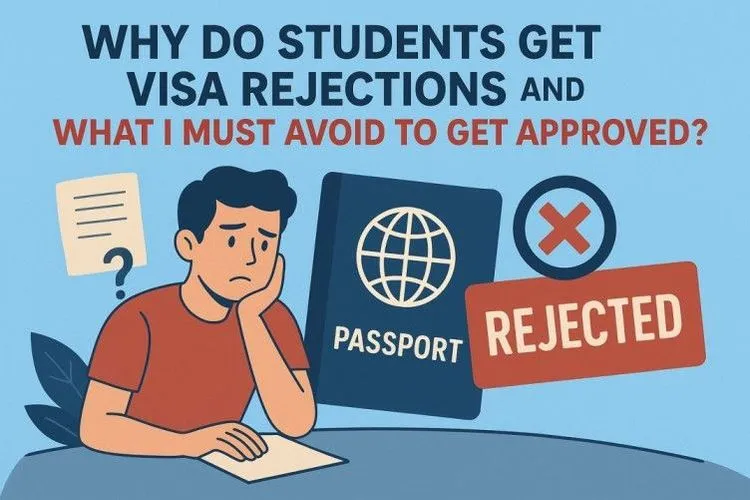
Yet thousands of qualified students get rejected every day.
It is heartbreaking. It costs time and money. It crushes confidence. But here is the good news. Rejections are rarely random. They happen for specific, logical reasons. If you know the reasons, you can fix them before you apply.
You do not need luck. You need a strategy.
This guide explains exactly why visas get denied and the specific steps you must take to get approved in the current, stricter immigration environment.
The Truth About Visa Rejections
Many students believe the visa officer was just having a bad day. This is rarely true. Visa officers are trained professionals. They follow strict laws.
It Is Not About Luck
Every country has an immigration act. The officer must follow it. They look for specific criteria. If you meet the criteria, you get the visa. If you miss one point, you get a rejection. It is a checklist, not a lottery.
The Consular Officer’s Mindset
You must understand their job. Their job is to protect their borders. In countries like the USA, Canada, and the UK, the officer is required by law to view every applicant as a potential illegal immigrant.
The burden of proof is on you. You must prove you are a genuine student. You must prove you will return home. If you leave room for doubt, they will deny you.
Financial Instability: The Number One Killer
Money is the most common reason for refusal. It is not just about having enough money; it is about the history of that money and meeting the significantly increased cost-of-living thresholds.
The Reality: New, Higher Financial Thresholds
Governments have recently and substantially increased the required proof-of-funds to ensure students can afford to live without relying on illegal work. Using old financial requirements is an automatic rejection.
- Example: Canada The minimum requirement for living expenses (for a single applicant, excluding Quebec) has been raised and is currently $22,895 CAD for the first year, plus tuition and travel costs.
- Example: UK Maintenance funds must cover tuition plus: £1,334 per month (London) or £1,023 per month (outside London), held for 9 months.
- The Checkpoint: You must show a substantial buffer above this official minimum. Showing the exact bare minimum suggests poor financial planning.
"Parking" Funds vs. Genuine Savings
Some students borrow money from friends to put in their account for a few days. They print the bank statement and return the money. Visa officers know this trick. They call it "funds parking."
Officers look at your average balance over six months. If your account usually has $500 and suddenly has $30,000, they will reject you. They need to see a history of savings. For countries like the UK, funds must be held for a continuous period (e.g., 28 days) immediately before applying.
Unexplained Large Deposits
Did you sell land? Did you get a bonus? You must prove the source. A large deposit without a paper trail looks suspicious. It looks like borrowed money.
Always include an affidavit or receipt for large deposits. Show where the money came from.
Insufficient Income to Sponsor Ratio
Your sponsor (usually parents) must show they can support you. But they also need money to live.
If your father earns $10,000 a year but promises to pay $25,000 for your fees and expenses, the math does not work. The officer will reject the visa because the financial plan is not realistic. Your sponsor’s income must be high enough to cover your fees and their own household expenses.
The "Potential Immigrant" Trap
This is the hardest part for students to understand. You are applying for a "non-immigrant" visa. This means you promise to go home after you graduate.
Understanding Non-Immigrant Intent and the "Genuine Student" Test
If the officer thinks you will stay illegally to work, they will deny you. This is often called "Section 214(b)" in the US. You must pass the Genuine Student (GS) Test (Australia) or the equivalent non-immigrant intent assessment (Canada, UK, USA).
New Red Flag: The Academic Downgrade
Visa officers are now strictly focused on Academic Progression.
- The Rule: Your new course must be a logical next step or at a higher level than your previous qualifications.
- The Danger: If you have a Master's degree from your home country but are applying for a basic diploma or undergraduate certificate abroad, this is highly suspicious. You must have a very strong, well-documented reason for the change, or you will face rejection.
Lack of Strong Home Ties
How do you prove you will return? You need "ties" to your home country.
- Economic Ties: Does your family own property or a business?
- Social Ties: Do you have a large family or community roles?
- Professional Ties: Do you have a job offer waiting for you when you return?
If you are young and have no assets, this is hard. You must explain your future career plans in your home country clearly.
Family Warning: Dependent Restrictions (Crucial for UK/Canada)
- UK: Students enrolled in most Master's programs and all undergraduate programs are no longer permitted to bring dependents (spouses/children).
- Canada: New rules also restrict which student categories can bring spouses on open work permits.
If you plan to bring family, you must confirm your exact program type is still eligible before applying.
Documentation Disasters to Avoid
Paperwork errors cause automatic rejections. There is no mercy for bad documents.
The Canada Requirement: Provincial Attestation Letter (PAL)
- For most new international students applying to Canada, your Letter of Acceptance (LOA) is no longer sufficient.
- You must include a Provincial Attestation Letter (PAL), issued by the province/territory where you will study.
- Critical: Your study permit application will be returned or refused if you apply without a valid PAL (or proof of a valid exemption). This document is now the mandatory gatekeeper.
Fraudulent or Fake Documents
Never use a fake document. Do not fake experience letters. Do not fake bank statements. Visa offices verify documents. If they catch a fake, you might get a 10-year ban. It is never worth the risk.
Academic Gaps Without Proof
Did you graduate three years ago? What have you done since then?
Sitting at home doing nothing is a red flag.
You must account for every month. If you worked, show pay slips. If you were sick, show medical records. If you were preparing for exams, write a statement explaining it. Do not leave the officer guessing.
Mismatched Information in Forms
Your visa application form (like the DS-160) must match your documents.
If the form says your father pays, but the bank statement is from your uncle, you will be rejected.
If the form says you want to stay 2 years, but the course is 4 years, it raises questions.
Review every detail. Consistency is key to credibility.
The Interview: Where Confusion Leads to Refusal
For countries like the USA, the interview is the deciding factor. You have two minutes to convince the officer.
Memorized Answers vs. Natural Responses & The AI SOP Trap
Do not memorize scripts from the internet. Officers hear the same answers all day.
Do not use generic AI (ChatGPT) to write your Statement of Purpose (SOP) or prep your answers. Your answers must be personal, detailed, and authentic.
- Bad Answer: "It has a big library and good faculty." (Generic)
- Good Answer: "It is the only university offering a module on Robotics AI which fits my plan to work in automation in my home country, specifically with the KCC Tech firm where they use that exact system." (Specific)
Be natural. Listen to the question. Answer the truth.
Not Knowing Your Course Details
You are a student. You must know what you are going to study.
If you cannot name your subjects or your major, the officer will assume you are not a genuine student. Read your syllabus before the interview. Know the credit hours. Know the professor's names.
Poor English Proficiency
If your course is in English, you must speak English. If you struggle to understand basic questions, the officer will wonder how you will survive in a university classroom.
You do not need a British or American accent. You just need to be clear and confident.
How to Guarantee Your Approval?
Now you know the dangers. Here is how you build a bulletproof application.
1. Build a Solid Statement of Purpose (SOP)
Connect your past studies to your future course (show academic progression). - Explain any gaps honestly. - Detail your career goals in your home country. - Show you have researched the university deeply. - Ensure it is 100% written by you and reflects your specific voice and career path.
2. Organize Financials Early (Use Updated Figures)
- Start preparing your bank accounts six months in advance.
- Verify the latest official cost-of-living requirements for 2025/2026 and budget to show funds 20-30% above the minimum.
- Collect tax returns for the last three years.
- Get a clear affidavit of support from your parents.
3. Secure Mandatory Pre-Approval Documents
- If applying to Canada: Confirm your institution has secured your Provincial Attestation Letter (PAL) and that it is included in your application package.
- If applying to the UK: Ensure your funds have been held for the continuous 28-day period required.
4. Mock Interview Preparation
Practice makes you perfect. Ask a friend or teacher to interview you. Focus on these three questions: - Why this country? - Why this university/course (and how is it a logical next step)? - How will you pay for it (using the new 2025 financial figures)?
If you can answer these three clearly, you are ready.
Conclusion
A visa rejection is not the end of the world, but it is an obstacle you want to avoid. The students who get approved are not the lucky ones. They are the prepared ones.
They show clear finances using updated 2025 thresholds. They explain their study plans logically with clear academic progression. They ensure they have all new mandatory documents (like Canada's PAL). They prove they are genuine students with a bright future back home.
Take the time to review your application. Check your documents. Practice your answers. Be honest and be specific. You have done the hard work to get the admission. Now finish the job and get the visa. Your future is waiting for you.
FAQs
Why do student visas get rejected most often?
Common reasons include insufficient financial proof, incomplete documents, weak academic history, unclear study intentions, and doubts about returning home after studies. Ensuring strong documentation helps reduce rejection risk.
How can I avoid getting my student visa rejected?
Prepare complete documents, show genuine study intent, provide strong financial evidence, maintain academic consistency, and be confident and clear during your visa interview.
Does low academic performance affect student visa approval?
Yes. Visa officers may question your ability to succeed academically. Pair lower grades with strong test scores, a clear study plan, and a compelling statement of purpose.
Can financial issues cause student visa refusal?
Absolutely. If you can't show enough funds for tuition and living expenses, your visa may be denied. Provide bank statements, sponsorship letters, or scholarship documents as solid proof of funds.
What should I do if my student visa gets rejected?
Review the refusal letter, fix the issues mentioned, strengthen your documents, and reapply with improved evidence. Sometimes addressing financial gaps or clarifying intentions is enough to get approved on the next attempt.