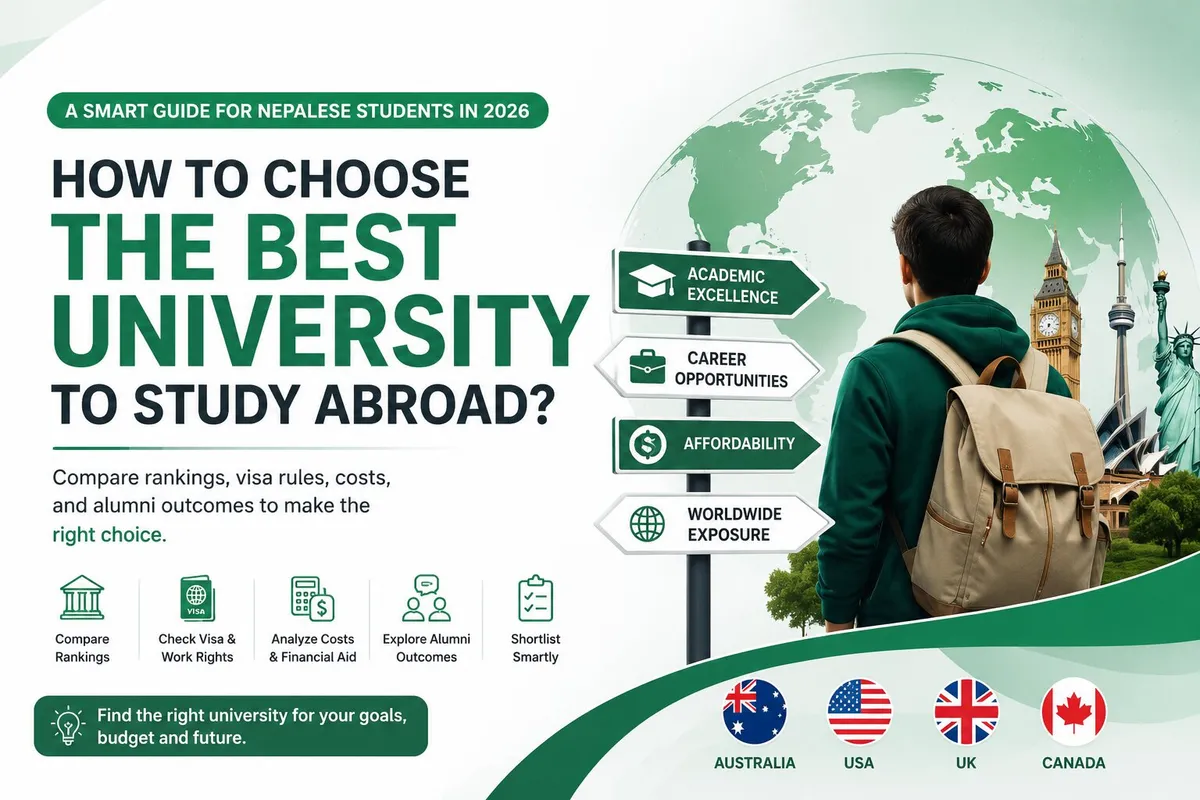
Choosing where to study abroad is one of the biggest financial and personal decisions you will make. It defines your network, your career trajectory, and your experiences for the next few years.
Many students look at a ranking list. They pick the top name. They apply. This is a mistake.
A university might be number one in the world but wrong for you. It might lack your specific specialization. It might be in a city you hate. It might blow your budget.
You need a systematic approach to filter thousands of options down to the perfect five.
Here is the step-by-step process to choose the right university that fits your future.
Step 1: Define Your Academic and Career Goals
You must start with the "Why" before you look at the "Where." Your goal is not just to get a degree. Your goal is to launch a career. The right university serves as a bridge to that career.
Identify Your Niche
Do not just choose "Engineering." Be specific. Do you want "Renewable Energy Engineering" or "Civil Engineering with a focus on Urban Planning"?
Universities often specialize. One university might be average overall but world-class in Marine Biology.
Action: Write down your specific area of interest.
Action: Look for modules within courses that excite you.
Match the Syllabus to Your Learning Style
Different universities teach differently. Some focus on theory. Others focus on practical application.
Research Universities: These focus on academic papers and theory. They are great if you want a PhD later.
Universities of Applied Sciences: These focus on hands-on skills and internships. They are great for immediate employment.
Check the course content on the university website. See how they assess students. Do they use exams? Do they use projects? Pick the style that fits you.
This leads us to the environment where you will study.
Step 2: Evaluate Location and Lifestyle
You will spend more time outside the classroom than inside it. The city you choose impacts your happiness and your wallet.
Climate and Environment
Think about your daily life. Can you handle six months of snow? Do you hate extreme heat?
A student from a tropical country might struggle in Northern Canada. A student who loves nature might feel trapped in London or New York.
Urban vs. Rural: Big cities offer internships and nightlife. Small college towns offer community and safety.
Weather: Check the annual weather patterns.
Safety and Culture
You need to feel safe. You also need to feel welcome. Research the safety index of the city. Look at the international student population. A diverse city makes it easier to find food you like and people who understand your background.
Tip: Use Google Maps to "walk" around the campus neighborhood. Look for grocery stores and bus stops.
Your location choice will heavily influence your budget.
Step 3: Analyze the Total Cost and Scholarships
This is usually the deciding factor for most students. You must calculate the Return on Investment (ROI).
Tuition Fees vs. Living Costs
A university with low tuition might be in an expensive city. A university with high tuition might be in a cheap town. You must look at the total package.
Tuition: The cost of the course.
Living Expenses: Rent, food, transport, and insurance.
For example, studying in a smaller German city might be free (tuition-wise) and cheap to live. Studying in London will have high tuition and high rent.
Financial Aid Opportunities
Do not assume you cannot afford a top school. Many expensive universities offer generous financial aid.
Merit-based Scholarships: Based on your grades.
Need-based Grants: Based on your family income.
Government Scholarships: Offered by your home country or the destination country.
Search for the "Financial Aid" section on every university website. Note the deadlines. They are often months before the admission deadline.
Once the budget is set, you can look at reputation.
Step 4: Decode University Rankings and Reputation
Rankings are useful tools. However, they are often misunderstood.
Global vs. Subject Rankings
A university might be ranked #50 globally but #5 for your specific subject.
You should prioritize subject rankings. Employers in your industry know which schools are best for their field. They care less about the overall university brand.
- Use QS World Rankings by Subject.
- Use Times Higher Education (THE) by Subject.
Accreditation Matters
Ensure the university is recognized. Your degree must be valid in your home country. It must be valid globally.
Check if the program has specific industry accreditations. For example, business schools should have AACSB or EQUIS accreditation. Engineering schools should have ABET or equivalent accreditation.
Rankings get you an interview. Your skills get you the job.
Step 5: Investigate Career Support and Employability
You are studying to get hired. The university must help you achieve this.
Industry Connections
Does the university have partnerships with big companies? Do they host career fairs?
Look for "Industrial Placement" years or "Co-op" programs. These allow you to work while you study. This experience is vital.
Post-Study Work Options
Check the visa regulations. How long can you stay in the country after graduation?
- UK: Graduate Route (2 years).
- Canada: PGWP (up to 3 years).
- Australia: Post-Study Work stream (2-4 years).
A university in a region with a strong job market for your field is ideal. If you study Tech, being near Silicon Valley or Berlin is an advantage.
This practical support needs to be matched by personal support.
Step 6: Assess Campus Life and Student Support
Moving abroad is stressful. You will need support.
International Student Services
A good university takes care of its international students. Look for specific services:
- Airport pickup services.
- Orientation weeks.
- English language support.
- Visa counseling.
Housing and Facilities
Where will you sleep? On-campus housing is convenient. It helps you make friends. Off-campus housing offers more freedom.
Check the quality of the facilities. Look for modern libraries. Look for sports centers. Look for 24-hour study labs.
Now you have the data. It is time to get the real story.
Step 7: Get Personal Insights (The "Real" Review)
University brochures are marketing tools. They only show smiling students and sunny days. You need the truth.
Talk to Current Students
This is the most reliable source of information.
Unibuddy: Many universities use this platform to let you chat with student ambassadors.
LinkedIn: Search for alumni from your country who attended that university. Send a polite message. Ask about their experience.
Ask specific questions. "Is the housing expensive?" "Are the professors accessible?" "Is it hard to find a part-time job?"
Virtual Tours and Webinars
Visit the campus digitally. Attend virtual open days. These events allow you to ask admissions officers questions directly. They show you the campus layout. They give you a feel for the culture.
This final check validates your research.
Conclusion
Choosing the right university is about finding a place where you can grow, not just chasing a famous name. Trust the process of aligning your academic goals with your budget and lifestyle needs.
It is normal to feel overwhelmed by the options, but remember that you only need one right match to succeed. Focus on the facts and data you have gathered rather than getting lost in marketing hype. A well-researched decision is one you will never regret making.
Start by listing your top three priorities today and narrowing down your list of potential countries.
Frequently Asked Questions
When should I start researching universities abroad?
You should start at least 12 to 18 months before your intended start date. This gives you time for standardized tests, application preparation, and visa processing.
Should I prioritize university ranking or course content?
Always prioritize course content and subject ranking. You study the course, not the university. Employers value specialized skills over a generic brand name.
How many universities should I apply to?
Apply to 3 to 5 universities. Select one "Dream" school (ambitious), two "Target" schools (good fit), and one "Safety" school (guaranteed acceptance).
Do rankings affect my student visa chances?
Generally, no. Immigration officers look for a valid confirmation of acceptance from an accredited institution. However, some countries have specific visa streams for graduates of top-ranked universities.
Is it better to live on-campus or off-campus?
First-year students should choose on-campus housing. It simplifies the transition. It makes socializing easier. You can move off-campus in later years once you know the city.