Choosing a university abroad feels like staring at a hundred open doors at once. One wrong pick can cost you years, thousands of dollars, and a visa you can't use the way you hoped.
You're right to look past rankings. According to the QS World University Rankings, 36 US and 15 UK universities dropped over 20 places this year as new student caps and visa rules make it harder for international students.
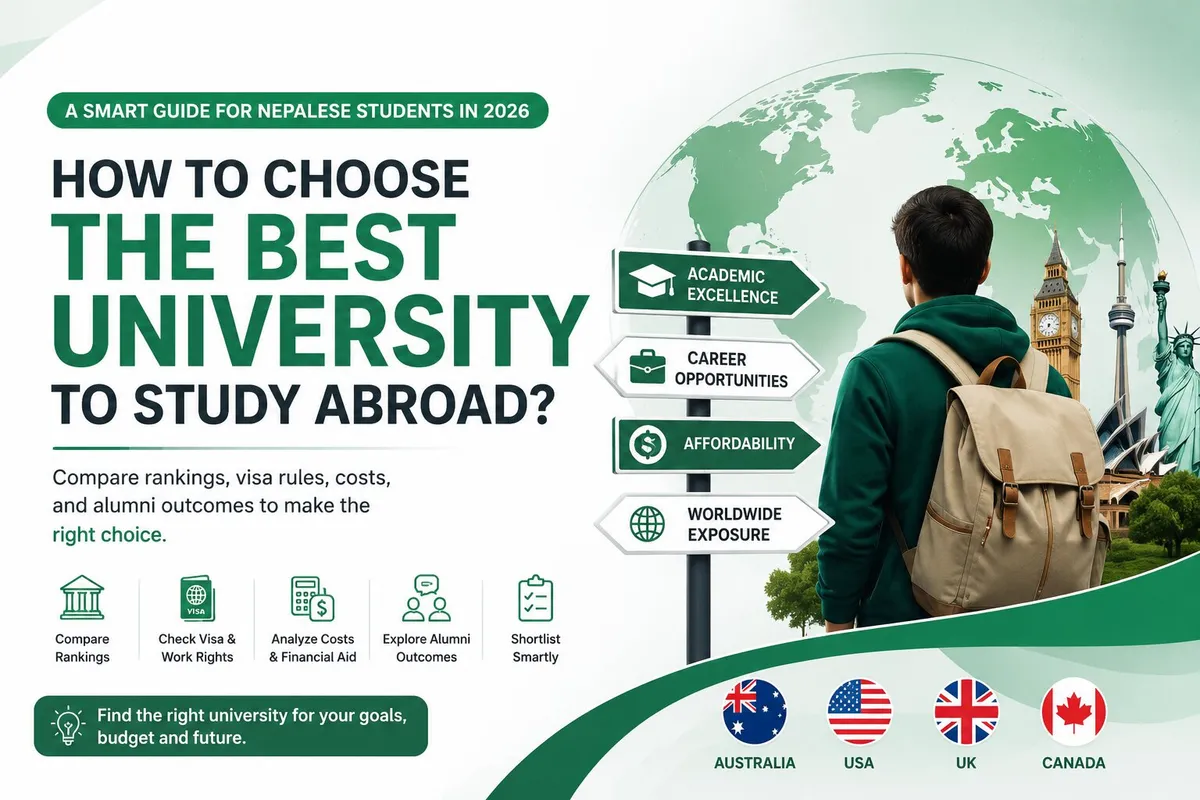
This guide breaks down exactly how to choose the best university to study abroad, not just the famous one, using course strength, visa rules, real costs, and alumni outcomes so you can shortlist with confidence.
KEY HIGHLIGHTS:
A university ranked 200th can run a top-tier program in your exact field, so check subject rankings, not just overall name.
Canada offers 3 years PGWP, UK 2 years, Australia up to 4 years, so compare post-study work rights before you apply.
Budget the full year, not just tuition. Add rent, insurance, and travel; a cheaper city with a solid university often beats an expensive big name.
Message graduates on LinkedIn about job outcomes and satisfaction before you commit to any university.
Build a shortlist of 5–10 reach, target, and safety universities to protect your chances of a strong offer.
What Students Need to Know Before Choosing a University to Study Abroad?
Before you compare university names or chase rankings, ask yourself a few honest questions. Your answers will narrow your options faster than any ranking table.
What is your field of study, and where is it actually strong?
A university's overall global rank rarely reflects the strength of one specific department. A school ranked 200th worldwide can run one of the best nursing or computer science programs on the planet. Check subject-level rankings, faculty research output, and course modules, not just the university's overall name and reputation. Read the actual syllabus too, since two programs with the exact same title can teach completely different skills and lead to very different careers.
What are your career goals after graduation?
Your career goals should shape your country and university choice, not the other way around. If you want to work abroad after graduating, study the post-study work visa length, internship access, and how strong the university's employer connections are in your industry. If you plan to return to Nepal, prioritize global recognition, research quality, and alumni who now work in your target field back home. This one decision affects almost every other choice you make.
What support services does the university offer?
International student offices, mental health counseling, housing assistance, and active student clubs matter far more than most students expect once they land in a new country. A university with a strong Nepali or South Asian student society can make orientation, house-hunting, and part-time job searching much less stressful. Ask current students directly through LinkedIn or Facebook groups before deciding, since official brochures rarely tell the full, honest story.
Can you genuinely afford it, including living costs?
Tuition fees are only one part of your real budget. Add rent, groceries, transport, health insurance, phone bills, and books before comparing two offers side by side. A cheaper city with a solid, mid-ranked university often beats an expensive city with a slightly bigger name, especially once loan interest and rising living costs pile up over two or three years. Calculate a full year's real cost, not just the advertised tuition figure, before you sign anything.
Does the entry criteria match your academic profile?
Be brutally honest about your grades, English test scores, and portfolio before you apply anywhere. Applying only to reach schools wastes months of preparation and thousands of rupees in application fees, often with very little chance of an offer. Build a realistic mix of reach, target, and safety universities based on your actual academic profile, not your dream outcome. This approach protects your timeline and still gives you a genuine shot at strong offers.
How to Choose The Right University to Study Abroad?
Choosing the right university is not about picking the most famous name. It is about finding the institution that matches your goals, your budget, and your academic profile. Students who get this decision right usually spend weeks comparing options, not hours.
Rankings matter, but they are only one piece of the puzzle. Two universities with similar global rankings can offer completely different experiences depending on course structure, city, visa support, and cost of living. The right choice always depends on your personal priorities, not someone else's list.
Below is a practical, step by step way to evaluate any university abroad. Use these five factors together, not one at a time, and you will make a far more confident decision.
1. Compare Course Curriculum Over Rankings
Global rankings like QS or Times Higher Education are useful for spotting strong institutions, but they do not tell you what you will actually study. The same degree title can look completely different from one university to another.
Look closely at the exact modules, electives, and teaching style. Decide whether you want hands-on practical training or a research-heavy program, then match that to the course structure, not just the university name.
2. Check Post-Study Work Visas and Immigration Policies
Where you study largely decides where you can work afterward. Compare the post-study work rights before you apply, not after you receive an offer.
Canada offers up to a three-year Post-Graduation Work Permit for eligible programs. The UK's Graduate Route currently grants a two-year post-study work visa. Germany offers an eighteen-month job-seeking visa for international graduates. Australia's Temporary Graduate Visa gives two to four years of work rights depending on your degree level and location.
3. Analyze Total Costs and Financial Aid
Do not focus only on tuition fees. Add the full cost of living, health insurance, and travel before you compare two countries or cities.
Many public universities in Europe offer heavily subsidized tuition, while some institutions rely almost entirely on international student fees to operate. Always check the university's own financial aid page along with country-specific scholarships such as Chevening in the UK, DAAD in Germany, or the Fulbright Program in the US.
4. Use Alumni Networks Before You Commit
Before you finalize any university, find out what its graduates are actually doing now. LinkedIn is the fastest way to do this.
Search for alumni from Nepal or your current university who studied at your target institutions. Send a short, polite connection request and ask about their job search experience and overall satisfaction with the program. Real answers from real graduates matter more than any brochure.
5. Shortlist and Categorize Your Choices
Apply to a mix of five to ten universities to maximize your chances of getting in somewhere strong. Divide your list into three groups:
Reach universities: where your profile sits slightly below the average admitted student.
Target universities: where your grades and test scores closely match the typical applicant.
Safety universities: where you are highly likely to be accepted based on your current profile.
This mix protects you from rejection while still giving you a shot at your dream university.
Top Universities to Study Abroad for Nepalese Students
Every year, thousands of Nepalese students leave home to study in Australia, the US, the UK, and Canada. Each country offers a different mix of cost, visa rules, and career outcomes, so the "best" choice really depends on your own priorities and budget.
Australia and the UK tend to attract students who want shorter, career-focused programs and clear post-study work pathways.
Canada appeals to students chasing a straightforward route to permanent residency, while the US remains the top pick for students targeting elite research universities and long-term careers in tech or engineering.
Most Nepalese students end up concentrated in a handful of cities and universities where strong Nepali communities already exist. Melbourne, Sydney, and Adelaide in Australia, Northumbria and Coventry in the UK, and Toronto in Canada all host large, active Nepali student groups that make settling in far easier.
Let's look at each destination in detail.
Top Universities for Nepalese Students in Australia
Australia remains one of the most popular destinations for Nepalese students, ranking third worldwide after China and India in terms of student numbers sent to Australian institutions. Nine Australian universities sit in the global top 100, giving students genuine access to world-class education without needing to compete for the handful of spots at Oxford or MIT.
The country's biggest draw is its balance of academic quality and post-study work rights. The Temporary Graduate Visa offers two to four years of work rights depending on your degree and location, and regional universities offer extra migration points that many Nepalese students actively target.
Melbourne, Sydney, and Adelaide host the largest and most active Nepali student communities in Australia. Melbourne and Macquarie University in particular are known for large Nepali student associations that help newcomers with housing, orientation, and part-time work.
QS Rank 2025 | University | City | Best Course for Nepali Students |
14 | Melbourne | Business, Engineering, Research | |
18 | Sydney | Business, Law, Health Sciences | |
19 | Sydney | Engineering, Technology | |
30 | Canberra | Public Policy, Sciences | |
42 | Melbourne | IT, Business, Pharmacy |
Top Universities for Nepalese Students in the US
The United States remains the top global choice for students chasing elite research universities, cutting-edge labs, and long-term tech careers. The country hosts more than thirty universities in the global top 100, along with the OPT program, which lets STEM graduates work for up to thirty-six months after finishing their degree.
Costs vary enormously by state and institution. Public universities in states like Indiana or Arizona cost far less than private schools in New York or California, while offering comparable career outcomes for engineering and business students.
Most Nepalese students in the US cluster around a handful of universities with strong South Asian communities and solid job markets nearby. Purdue University in Indiana is especially popular among Nepali engineering students because of its academic strength and manageable cost of living.
QS Rank 2026 | University | State | Best Course for Nepali Students |
1 | Massachusetts | Engineering, Computer Science | |
88 | Indiana | Engineering, Agriculture | |
Top 100 | Illinois | Computer Science, Engineering | |
Top 100 | Washington | Computer Science, Public Health | |
Top 200 | Arizona | Business, Technology |
Top Universities for Nepalese Students in the UK
The United Kingdom is Nepal's most popular study abroad destination, with tens of thousands of Nepali students currently enrolled across UK institutions. Shorter degree lengths are the biggest draw: most Master's programs take just one year, cutting both tuition and living costs compared to a two-year US degree.
The Graduate Route visa currently offers two years of post-study work rights, giving students a real window to find a job before their visa expires. This is expected to shorten to eighteen months from January 2027, which is pushing many students to apply earlier.
Northumbria, Coventry, and Middlesex are common entry points for Nepali students thanks to established communities and accessible entry requirements, while Russell Group universities like Manchester and Birmingham attract students chasing stronger global recognition.
QS Rank 2026 | University | City | Best Course for Nepali Students |
2 | London | Engineering, Medicine | |
4 | Oxford | Law, Humanities, Medicine | |
Top 50 | Manchester | Business, Engineering | |
Top 100 | Birmingham | Business, Social Sciences | |
Top 250 | Newcastle | Business, Computer Science |
Top Universities for Nepalese Students in Canada
Canada attracts Nepalese students with its clearer pathway to permanent residency, lower tuition than the US or UK, and strong industry-aligned programs in engineering, business, and computer science. The Post-Graduation Work Permit gives eligible Bachelor's, Master's, and PhD graduates up to three years of work rights.
Costs in Canada sit noticeably lower than in the US or Australia, with total yearly expenses generally ranging between NPR 25 lakhs and 55 lakhs depending on the province and program. Public institutions in Ontario and British Columbia remain the most sought after among Nepali applicants.
Toronto and Vancouver host the largest concentration of Nepali students in Canada, drawn by job availability, established communities, and strong transit connections to major employers.
QS Rank 2026 | University | Province | Best Course for Nepali Students |
Top 30 | Ontario | Engineering, Computer Science | |
Top 40 | British Columbia | Business, Sciences | |
Top 40 | Quebec | Medicine, Research | |
Top 150 | Alberta | Engineering, Agriculture | |
Top 250 | Ontario | Business, IT |
Conclusion
Every great study abroad story starts the same way: a student overwhelmed by choices, a spreadsheet full of rankings, and a quiet fear of picking wrong. But by now, you know the truth. The right university was never the one with the biggest name. It was always the one that matched your course, your budget, your career goals, and your life after graduation.
That's the real shift, from chasing rankings to choosing fit. Whether you land in Melbourne, Toronto, Manchester, or Boston, the students who thrive are the ones who did the research, asked real alumni honest questions, and built a shortlist of reach, target, and safety schools instead of chasing one dream address. You don't need a top-10 university to build a top-tier future. You need the right one, for you.
So take a breath. You've already done the hardest part, learning how to ask the right questions before you apply. Now it's time to turn that research into action: shortlist your five to ten universities, check the visa pathways, and start reaching out to alumni today. Your study abroad journey isn't just about getting in somewhere. It's about landing exactly where you belong, and building a future you're proud of.
Frequently Asked Questions
How to be a top 1% student?
Consistent daily study habits, active class participation, strong time management, and seeking feedback from teachers regularly set top-performing students apart. There is no shortcut; it comes down to steady effort over time.
Which university is best for study abroad?
There is no single best university for every student. The right choice depends on your field of study, budget, career goals, and preferred country. Compare course curriculum, visa rules, and costs before deciding.
How do I decide which university is best for me?
Start by listing your must-haves: course quality, budget, location, and post-study work rights. Then shortlist five to ten universities across reach, target, and safety categories, and compare them against that list.
How to pick a study abroad program?
Match the program's curriculum and structure to your career goals first, then check accreditation, cost, and post-study work opportunities in that country before applying.
Which country is best for study and work for nepali students?
Canada leads for combined study and work, thanks to its 3-year PGWP and clear path to permanent residency. Australia follows closely, offering strong part-time work rights and a large, active Nepali student community.
Which country gives 100% scholarships?
Countries like Germany, Norway, and Finland offer tuition-free or heavily subsidized public education to international students, while need-based full-ride scholarships are also available in the US and UK for exceptional applicants.
What country is best to study abroad in?
It depends on your priorities. Choose the UK for shorter degrees, Canada for a clearer PR pathway, Australia for a strong balance of work rights and lifestyle, and the US for globally elite research universities.