A good study abroad consultancy gives you honest, unbiased advice and saves you time. A bad one pushes you toward whichever university pays it the highest commission.
Both look similar from the outside: a nice office, a friendly counselor, a stack of university brochures. The difference only becomes clear once you ask the right questions, which is exactly what this guide walks you through.
Before you pay anyone, use the checklist below. And know this going in: for many students, free tools plus honest advice from someone who has actually studied abroad cover most of what a paid consultancy does.
Platforms like UniCoachify exist for exactly this reason, pairing free research tools with real student mentors so you are not starting from zero before you ever set foot in an office. A consultancy can still be worth it, but only if it passes the tests in this article.
Why Choosing the Right Consultancy Matters so Much?
Picking a study abroad consultant is not like picking a tutor for a single subject. The advice you get shapes which country you apply to, which university accepts you, how much debt you take on, and whether your visa application succeeds or gets rejected.
A single bad recommendation, like being pushed into a low-ranked partner university that does not fit your goals or budget, can cost you a year and a significant amount of money.
The study abroad consultancy industry is also unevenly regulated. Some consultancies are licensed, experienced, and genuinely student-first. Others are sales operations dressed up as advisory services, earning commission from university partners and steering students accordingly.
Both types can look identical in a first meeting. That is why you need a structured way to evaluate them rather than relying on gut feeling or a glossy website.
What a Good Study Abroad Consultancy Actually Does?
It recommends universities that fit you, not its commission structure
A good consultant asks about your academic background, budget, career goals, and personal preferences before suggesting anywhere. The recommendation should follow from your profile, not from a list of "partner universities" the consultancy is contractually pushing.
If every conversation somehow ends at the same three or four schools regardless of what you tell them about yourself, that is worth noticing.
A useful way to sanity-check any recommendation is to run your own profile through an independent university finder first. If the tool surfaces a much wider range of good-fit options than your consultant mentioned, that gap is worth asking about.
It is transparent about money
A trustworthy consultancy tells you plainly what is free, what you pay for, and whether it earns commission from any university it recommends. Commission-based models are common and not inherently dishonest, since many reputable agencies are compensated by universities for successful placements.
The problem is not commission itself. The problem is a consultancy that hides it or lets it quietly override your best interests.
It gives realistic advice, including bad news
Real consultants tell you when a plan will not work. If your grades, English test score, or budget do not match your target university or country, a good consultant says so early rather than taking your money and letting the university or embassy deliver the bad news later. Overpromising is one of the clearest signs of a service built around sales targets rather than student outcomes.
It supports the whole journey, not just the application
Course and university selection is only the beginning. Strong consultancies also help with English test preparation guidance, scholarship research, statement of purpose feedback, visa document preparation, and pre-departure planning. If a consultancy's support ends the moment you pay the application fee, you are paying for a fraction of the service you actually need.
It has verifiable, named people behind it
You should know who is advising you, and you should be able to check their background. Look for named counselors, not just a generic "team," and check whether they hold any recognized accreditation or professional certification in international education counseling. Experience matters more than a polished office.
This is also where talking to someone who has actually lived the process helps more than any brochure. A quick session with a verified study abroad mentor who has already gone through your target country's application and visa process gives you first-hand, commission-free perspective before you commit to paying anyone.
How Consultancies Actually Make Money (and Why it Matters)
Most study abroad consultancies operate on one of three models: fully commission-based (paid by universities per successful enrollment), fully fee-based (paid directly by students), or a hybrid of both. None of these models is automatically better than the others, but each carries a different risk.
Commission-only consultancies can be genuinely free to students, which is appealing, but their income depends on getting you enrolled somewhere, not necessarily the somewhere that is best for you. Fee-based consultancies charge you directly, which removes some of that pressure but adds an upfront cost regardless of outcome. Hybrid models mix both incentives.
None of this means you should avoid commission-based consultants. Many highly reputable agencies work this way, including some affiliated with recognized bodies in the sector. What it means is that you should always ask directly how a consultancy is paid, and treat "it's completely free" as a reason to ask more questions, not fewer.
Warning Signs to Walk Away From
"Guaranteed admission" or "guaranteed visa."
No consultant controls a university's admissions committee or an embassy's visa officer. Anyone who promises a guaranteed outcome is either inexperienced or being dishonest with you, and either way it is a reason to leave.
Pressure to apply only to "partner" universities.
If every suggestion happens to be a school the consultancy has a paid relationship with, and they resist discussing alternatives, the advice is likely commission-driven rather than profile-driven.
Vague or hidden fees.
Ask what the total cost is, in writing, before you sign anything. If a consultancy cannot give you a clear breakdown of what is included, from application fees to visa filing to SOP editing, do not pay until they can.
No named, verifiable people advising you.
Be cautious of consultancies that rotate you between different staff with no clear point of contact, or that cannot tell you who specifically will handle your file.
Fake or overly polished reviews.
Genuine student testimonials usually include specific details: a university name, a course, a rough timeline. Reviews that read like marketing copy, with no specifics and suspiciously uniform praise, are worth treating with skepticism. If the reviews look manufactured, assume the rest of the marketing might be too.
Rushed decisions.
Any consultancy pressuring you to sign a contract or pay a deposit "today only" is using a sales tactic, not giving you advice. A legitimate consultant expects you to take time to think it over.
Questions to Ask Before You Pay Anyone
A short conversation reveals more than any website. Ask these questions directly, in this order if you can, and pay close attention to how comfortably a consultant answers them, not just what they say.
Expertise & Authenticity
What are your credentials?
A trustworthy study abroad consultant should hold certification from a recognized body like ICEF or the British Council, or show clear relevant training in international education counseling. If they cannot name one, that is worth asking about directly.
Do you have established partnerships with universities in my target country?
Ask whether the consultancy represents your target universities directly through an official agreement, or simply forwards your documents through a third party. Direct study abroad university partnerships usually mean faster processing and clearer communication.
Can you connect me with past students?
A genuine study abroad consultancy will happily share contact details or references from real students it has actually placed, not just polished quotes on its own website. If they hesitate, delay, or dodge this request outright, treat it as a clear warning sign.
Course & University Selection
Why are you recommending these specific universities?
The answer should tie directly and specifically to your grades, budget, and career goals, not repeat a generic list of "our top partner schools." If every student hears the exact same university shortlist, the advice is not actually personalized to your profile.
What are the post-study work rights?
Ask the consultant to explain realistic post study work visa rules for your target country, including how long you can legally stay and work after finishing your degree. Vague, rushed, or overly optimistic answers here deserve more digging before you pay.
Can you help improve my profile?
A good consultant should offer real, hands-on guidance on raising your IELTS or PTE score and meaningfully strengthening your statement of purpose, not simply forward your existing documents unchanged. Genuine profile-building support signals real investment in your outcome.
Cost & Payment Terms
What is your full fee structure?
Request a complete, written breakdown of every cost involved, including application fees, service charges, visa filing, and any extras, before you pay a single deposit. Hidden charges that surface later are one of the clearest signs of a bad consultancy.
What is your refund policy?
Clarify in writing what happens to your fees if your student visa is refused or you change your mind, whether that means a partial refund, a second attempt, or clearly defined next steps. No clear answer means they have no real plan for your worst case.
Do you charge for university applications?
Confirm clearly whether application filing to your shortlisted universities is already bundled into your package price or billed as a separate charge per school. This one detail alone can quietly shift the real total cost of a full study abroad consultancy package.
Visa & Post-Arrival Support
What does your visa support include?
Good visa support should go well beyond a basic document checklist, including a careful review of your financial proof and realistic mock visa interviews to build your confidence. If support stops at paperwork, ask what happens with follow up questions.
Do you help with accommodation and travel?
Ask whether the consultancy also assists with finding student housing, booking flights, or arranging airport pickup once your student visa is approved. Support that quietly ends at the visa stamp leaves you managing arrival logistics entirely on your own.
Good advisers welcome every one of these questions without hesitation. Anyone who gets defensive, vague, or annoyed is telling you something important before you have paid a single rupee, dollar, or pound.
How to Verify a Consultancy is Legitimate?
A conversation can only tell you so much. The fastest way to confirm a consultancy is real is to check them against official records rather than take their word for it, and it only takes a few minutes if you know where to look.
Government & Legal Verification
Cross-check the consultancy's name against Nepal's official CIMS consultancy portal, and ask to see their company registration certificate plus PAN or VAT documents. A firm that cannot produce these on request has no legal basis to be advising students in the first place.
Physical & Digital Presence
Confirm the office address is real, not just a listing, by checking it on Google Maps or visiting in person, since scam operators often use temporary addresses to dodge authorities. Then check their online history for consistent, long-term activity and reviews that read as genuine.
Service & Financial Red Flags
Treat any promise of a guaranteed visa or guaranteed admission as an immediate red flag, since only an embassy officer or admissions committee makes that call, never a consultant. Insist on a written invoice and milestone-based payments instead of handing over cash upfront.
Background & Partnerships
Ask for contactable references from past students rather than quotes pasted on a webpage, and check for membership in a recognized body such as ECAN or ICEF. Genuine affiliations and traceable references add a layer of accountability a pure sales pitch simply cannot fake.
And if the consultancy claims partnerships with specific universities, you can often verify this directly on the university's own website, which frequently lists its official recruitment agents.
Do you Even Need a Consultancy?
Often, no. Direct applications are possible for most universities, and the single highest-value form of help is honest guidance from someone who has actually been through the process. That is why many students now combine a few low-cost or free resources instead of paying for full-service consulting upfront:
A university finder to shortlist schools that actually match your grades, budget, and goals, instead of the same three names every agent pushes.
A scholarship finder to search funding options independently, rather than relying on a consultant to mention only the scholarships tied to their partner schools.
A mock English test for IELTS, PTE, or GRE, so you know exactly where your score stands before paying anyone for test coaching.
A short conversation with a current student mentor at your target university or in your target country, for first-hand, commission-free advice.
This combination gets most applicants a long way without any commission-driven pressure. A paid consultancy makes the most sense when you want deeper, hands-on help with a complex profile, such as a gap year to explain, a career change, or a country with an unusually demanding visa process. Even then, only use one that passes the checklist above.
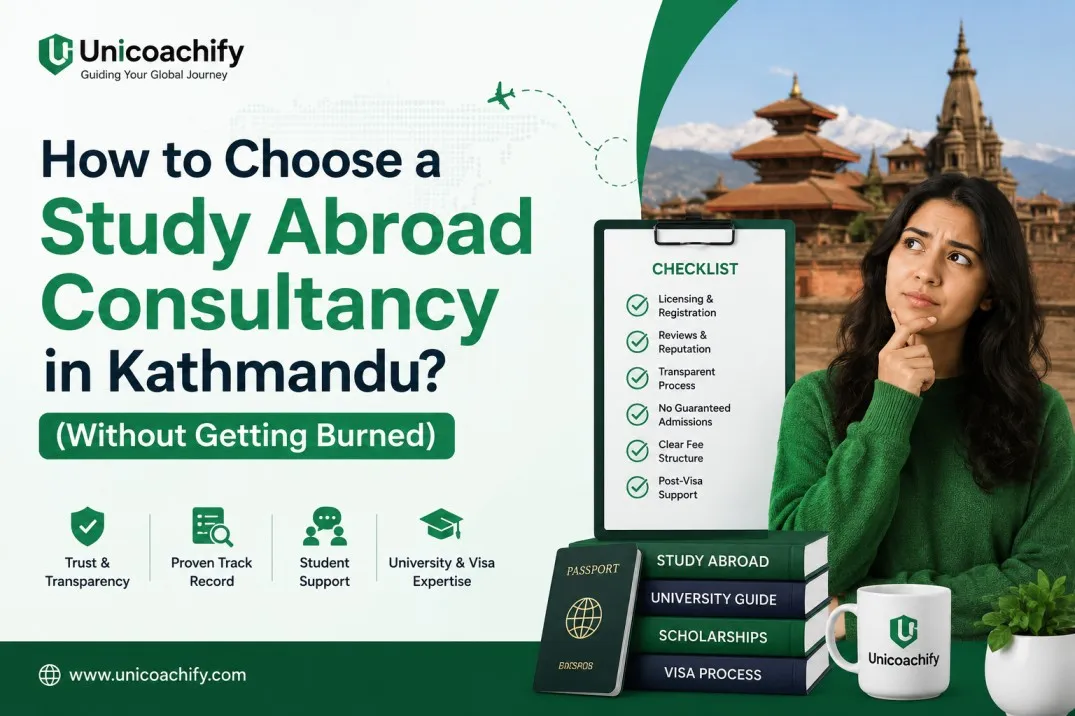
Before making any payment, confirm that you can answer "Yes" to each item on this simple pre-payment checklist:
I understand exactly how this consultancy is paid, and by whom.
I have a written breakdown of every fee, with nothing left vague.
I know the name and background of the specific person advising me.
No one has promised me a guaranteed admission or guaranteed visa.
I have checked at least one independent review or reference outside the consultancy's own website.
I was given time to think it over, without pressure to sign immediately.
If any of these is missing, pause before you pay.
Full-Service vs a La Carte: Which Model Fits You
Not every consultancy offers the same shape of service, and knowing the difference helps you avoid paying for support you do not need.
Full-service consultancies
Handle everything from country selection to pre-departure briefing under one package. This suits students who want a single point of contact and minimal back-and-forth, but it usually costs more, and you are trusting one team with every decision along the way.
A la carte consultancies
Let you pay only for specific pieces, such as SOP editing, visa document review, or a single university shortlist session. This works well if you are comfortable handling research and applications yourself but want expert eyes on the parts where mistakes are costly, like your statement of purpose or your financial documentation for a visa.
Test-prep-only Services
Focus purely on IELTS, PTE, or GRE coaching without touching applications at all. If your English or standardized test score is the only weak point in your profile, this narrower option can save significant money compared with a full package. Before paying for coaching, it is worth taking a free IELTS, PTE, or GRE practice test to confirm that test prep is actually where you need to invest.
Before you commit to a package, ask yourself honestly which parts of the process you can manage on your own and which parts genuinely need expert review. Paying for a full-service package when you only need help with one or two steps is one of the most common ways students overspend. If that describes you, try the free tools and mentor network at UniCoachify before you pay anyone for a full package.
Comparing Multiple Consultancies Before You Decide
Do not evaluate a single consultancy in isolation. Speak with at least two or three before committing, using the same set of questions from this guide with each one.
Pay attention not just to what they say but to how consistent their answers are. A consultancy that gives you a clear, specific breakdown of costs and options is behaving very differently from one that gives you a vague, reassuring pitch with no real detail.
It also helps to compare the actual universities being recommended across consultancies. If one consultancy suggests a wide range of schools that match your stated goals and budget, while another keeps returning to the same narrow list regardless of what you tell them, that pattern alone tells you a lot about which one is working in your interest.
Get a Free Second Opinion Before You Decide
You do not have to choose between "pay a consultancy" and "figure it all out alone." Unicoachify is built as an all-in-one, student-first alternative you can use alongside or instead of a paid consultancy:
Find a fit-based shortlist with the university finder
Search funding with the scholarship finder
Check your readiness with free IELTS, PTE, and GRE practice tests
Talk to a real student mentor who has already been through your target country's process
None of it is tied to a commission on your enrollment, so you can use it as an honest baseline before you ever sign with a paid consultancy.
Conclusion
A study abroad consultancy can genuinely simplify a complicated process, but only when it is chosen carefully.
Ask direct questions about money, insist on realistic answers instead of guarantees, verify who is actually advising you, and remember that you always have the option to handle parts of the process yourself using free tools and first-hand student advice.
The right consultancy, chosen this way, becomes a partner in your plan. The wrong one becomes an expensive lesson. The checklist above is designed to make sure you end up with the former.
Frequently Asked Questions
How much does a study abroad consultancy cost?
Costs range from free, when the consultancy is paid by university commissions, to substantial paid packages for full-service support. "Free" is not automatically neutral. If a consultancy earns commission from universities, its recommendations may lean toward its paying partners, so always ask how it makes money regardless of the price tag.
Are free study abroad consultants trustworthy?
Many are. Commission-based consulting is a normal, legitimate business model used by well-established agencies. The key is transparency: a trustworthy free consultant tells you upfront which universities pay them and does not hide behind vague answers when asked directly.
What's the difference between a study abroad agent and a study abroad consultant?
In practice the terms are often used interchangeably. Some agents work as official recruitment representatives for specific universities and are compensated accordingly, while independent consultants may charge students directly. Ask which category a given service falls into so you understand the incentive behind their advice.
Can I apply to study abroad without any consultancy at all?
Yes. Most university applications can be submitted directly through the institution's own portal, and many countries publish clear, official visa guidance for prospective students. A consultancy adds value mainly when your case is complex or when you want hands-on support through every step, not because direct applications are impossible. Free tools like a university finder and a scholarship finder can cover much of the initial research on your own.
What should I do if I think a consultancy has misled me?
Document everything in writing, including emails and any promises made verbally that you can follow up in writing. If the consultancy is registered with a professional body or regulator, that is the right place to file a complaint. Reviewing a contract before signing, rather than after a problem appears, remains the best protection.
Should I choose a consultancy based on which country it specializes in?
Specialization can be a genuine advantage, since a consultancy that focuses on one or two countries usually has deeper, more current knowledge of that country's visa rules and university requirements than one that claims expertise everywhere. But specialization should never override fit. If a country-specialist consultancy keeps recommending its specialty even when your profile and goals point elsewhere, treat that as a conflict of interest rather than genuine advice.
Is a bigger, more well-known consultancy automatically safer than a smaller one?
Not necessarily. Size and brand recognition can indicate stability, but they say little about whether a specific counselor will give you honest, personalized advice. Some of the best outcomes come from smaller, independent consultants who take on fewer students and know each case in depth, while some large chains rely on junior staff following a script. Judge the individual advising you, not just the name on the office door.