Every year, thousands of Nepali students lose months, money, and motivation chasing advice from people who have never once sat inside a foreign university. As the saying goes, don't ask the barber if you need a haircut. The right guidance changes everything.
This guide cuts through the noise. From choosing the right country to writing your SOP, building your CV, and booking your visa, every step you actually need is right here, in the right order, explained clearly.
By the end of this page, you will know exactly what to do, when to do it, and who can help you do it right. No recycled tips. No paid consultancy spin. Just the complete, honest roadmap to getting admitted to a foreign university in 2026.
Which Country Is #1 for Studying Abroad?
Every year, students searching for the 'best country to study abroad' are met with recycled lists that lack real-world context. This generic advice often does more harm than good, causing students to feel overwhelmed and stuck in the decision-making process.
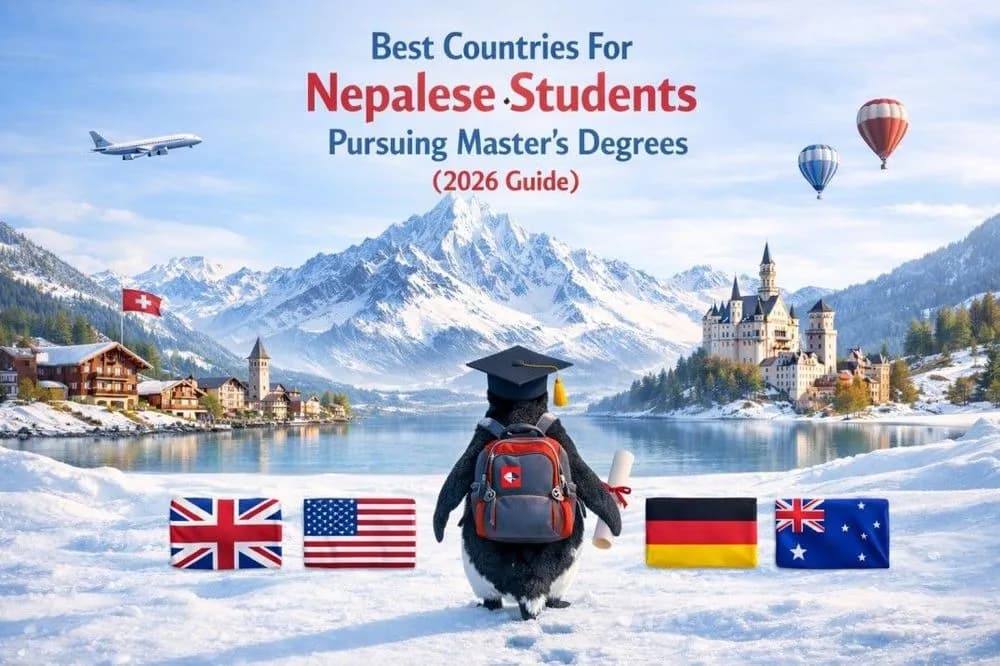
According to the QS Best Student Cities 2026 report, the top-ranked destinations for international students based on university quality, affordability, student mix, and employer activity are:
The United States: Home to 8 of the world's top 10 universities. Unmatched for STEM, MBA & research, but plan for $30k–$60k/yr in tuition before you apply.
The United Kingdom: Get a globally respected degree in just 3 years, then stay 2 more on the Graduate Visa. Russell Group names open doors worldwide.
Germany: Public universities charge near-zero tuition; even for internationals. TU Munich & RWTH Aachen rank in Europe's top 10 for engineering.
Canada: One of the clearest PR pathways in the world via PGWP. But intake is now capped, choose a DLI-approved school and apply months early.
Australia: 7 universities in the global top 100. Stay up to 4 years post-graduation on the 485 visa, but living costs vary hugely by city.
So which country is actually #1 for you?
The truth is: No single country is #1 for everyone. The 'best' country depends entirely on your specific goals. To find your #1.
It depends on your goal. Germany wins on value, the US wins on prestige, and Canada wins on immigration. No single country leads in every category, your #1 is personal.
Your budget decides first. Under $20k/yr? Germany. Got $30k–$60k? The US or UK. Mid-range? Canada or Australia offer the best balance of cost and opportunity.
Then match your field. STEM? Germany or the US. Business? UK or Canada. Medicine? Australia. Pick the country where your degree carries the most weight with employers you actually want to work for.
What are the Requirements to get Accepted to a University Abroad?
Before you touch a single application form, three things must be in place.
First, you need a finalised university shortlist of 8 to 12 universities across three tiers: Reach universities where admission is competitive but possible, Target universities that match your profile and Safety universities where your qualifications comfortably exceed the minimum requirements.
If you have not built this list yet,you are not ready so please follow these things first.
Second, you need your English language test score in hand or a confirmed test date within the next 60 days. Most universities will not process applications without a valid IELTS, TOEFL, PTE, or Duolingo English Test score. Do not assume you will take the test after applying, you will miss deadlines.
Third, you need a clear picture of your finances. Universities require proof that you can fund your education before they issue a formal admission letter, and visa authorities require proof before they issue your student visa. Know your numbers before you start.
If all three are ready, you can begin.
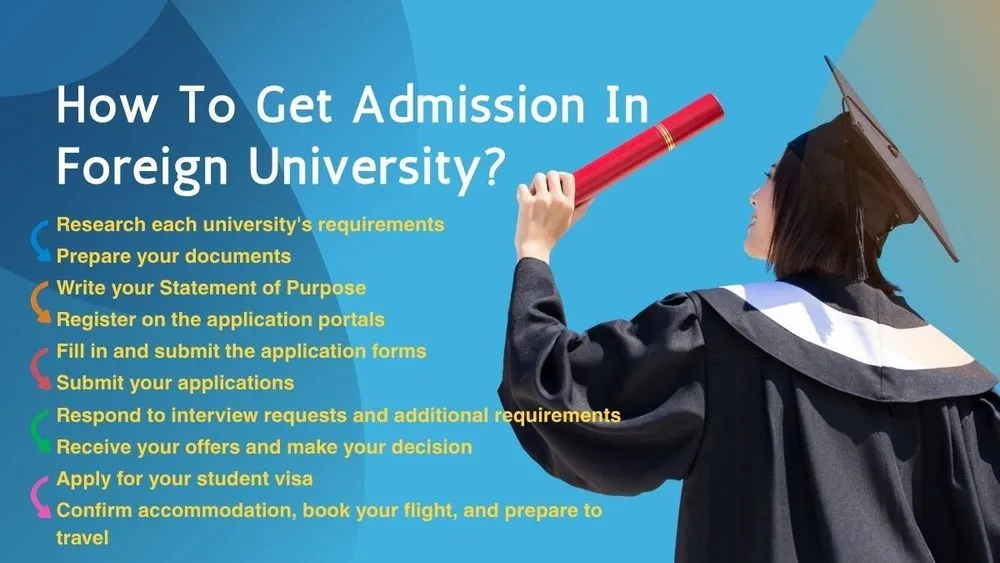
How To Apply to Foreign Universities from Nepal: Step-by-Step Admission Guide
Most students fail their study abroad applications not because their grades are bad or their English is weak.
They fail because they started too late, skipped a document, misread a deadline, or submitted a generic statement of purpose that sounded like every other applicant.
Step 1: Research each university's requirements
Every university is different. Do not assume what worked for one applies to another. Go to each university's official admissions page and note the exact GPA minimum for your specific programme, the English score required per band, whether GRE or GMAT is needed, and the application timelines including priority and regular deadlines.
Build one simple spreadsheet. One row per university. Columns for deadline, score requirement, documents needed, portal link, and fee. This one habit keeps your entire application process organised and stress-free.
Program options vary wildly even within the same university, the business school may want a GMAT while the engineering school doesn't. Always check at programme level, not university level.
Step 2: Prepare your documents
Document preparation takes longer than every student expects. Start everything in parallel. You need official academic transcripts sealed and sent directly from your institution, a valid English language certificate, a passport copy, and financial documents showing you can cover tuition plus living costs.
If you studied outside the country you are applying to, universities in the USA and Canada require a WES credential evaluation. This is a third-party process that translates your qualifications into the local grading system. It takes three to seven weeks. Order it the moment you decide to apply. This single step causes more delays than anything else in the international education application process.
Letters of recommendation require two to three academic referees. Contact them six to eight weeks before your earliest deadline. Give each referee a clear brief about your programme, your strongest work in their subject, and the qualities you would like highlighted. A specific letter from someone who supervised your thesis is worth far more than a generic letter from someone with an impressive title who barely knows your work.
Step 3: Write your Statement of Purpose
Your Statement of Purpose is the most important document you will submit. Grades and test scores get you considered. Your SOP is what gets you admitted. Write 700 to 1,000 words that answer five specific questions. Why this field. Why now? Why this specific university. What you bring to the programme. What you plan to do after graduation.
Name specific professors. Reference specific labs, courses, or research centres that exist at that university. Generic SOPs that read like they could have been sent to any institution are rejected at every competitive university. Admissions readers process hundreds of applications. They identify copy-paste writing in the first paragraph.
Write three drafts minimum. Get honest, critical feedback before you submit. Do not use AI to write it. Universities are actively detecting AI-generated text and a generated SOP will not reflect your actual experiences or answer the specific questions that particular university is asking.
Step 4: Register on the application portals
Each country uses a different system and you need to know which one applies before you start filling anything in. For the USA, most universities use the Common Application at commonapp.org. Some, including MIT, use their own portals.
For the UK, all undergraduate applications go through UCAS and you get five choices per application cycle. For Germany, most international applicants submit through uni-assist.de first. Canada and Australia both require you to apply directly through each university's own website.
Create every portal account using your legal name exactly as it appears on your passport. Use a professional email address that you check every day. Offer letters, document requests, and visa interview invitations arrive without advance warning. Missing one of these emails costs you real opportunities.
A name spelling error or a wrong date of birth on a portal account creates problems that follow you through to your student visa application. Set it up correctly the first time.
Step 5: Fill in and submit the application forms
Work at one university at a time. Start with the earliest deadline. Fill in your personal information exactly as your passport shows it. Enter your academic history completely and honestly. Universities cross-check every detail against your official transcripts. Any discrepancy, even a small one, can result in immediate rejection or withdrawal of an offer after acceptance.
Upload all documents as clear, correctly named PDF files. A blurry scan or a wrong file label is enough to have your application flagged. Budget between $30 and $150 per university for application fees. When you apply to multiple universities, these fees add up quickly and students are often caught off guard.
Read the entire form once more before you submit. Check the intake year. Check the programme name. Check every uploaded file. Mistakes after submission are difficult to correct and some cannot be corrected at all.
Step 6: Submit your applications
Do not wait for everything to feel perfect before you submit your first application. Submit your first three in weeks six or seven. Submit the next four in weeks eight or nine. Submit the final batch in week ten. Batching your submissions means you catch any errors on your early applications before repeating them across every university on your list.
Save every confirmation you receive. Screenshot the page. Save the email. Log the application reference number in your spreadsheet. You will need these if any issue comes up later with a specific university's admissions office.
Check your application portal every three to four days after you submit applications. Universities update document statuses as they receive them. If your transcript has not arrived on their end, you need to know quickly enough to chase your institution and fix it in time.
Step 7: Respond to interview requests and additional requirements
An interview invitation is a positive sign. It means your application cleared the initial review and you are being seriously considered. Interviews for study abroad programs are almost always conducted online and are not designed to catch you out. They want to confirm that the person described in the SOP is real, genuinely motivated, and can speak clearly about their field.
Prepare by re-reading your own SOP. Know your research interests well. Be ready to explain why you chose this specific programme and this specific university. Any relevant study abroad experience you have, such as exchange programmes, international internships, or cross-border research, is worth mentioning naturally in this conversation.
If a university asks for additional materials after submission, such as a writing sample, a research proposal, or a supplementary reference, respond within 48 hours. Students who delay these requests consistently lose their spot to candidates who respond faster.
Step 8: Receive your offers and make your decision
Offers arrive in waves. US universities send decisions between December and April for the September intake. UK decisions come through UCAS between January and May. German and Canadian universities release decisions on a rolling basis throughout the year. Students enrolled in early application rounds tend to hear back first.
Read every offer carefully before you respond. An unconditional offer means you are fully accepted. A conditional offer means you must meet a specific requirement, such as a final grade, a test score, or an additional document, before your place is confirmed. Check the deadline by which you must accept or decline. Missing this deadline means losing the place permanently.
If you receive multiple offers, compare them honestly. Look at programme quality, any scholarship or financial aid attached, post-study work rights in that country, and the real cost of living in that city. Pick the option that fits your goals and your budget, not the one that sounds most impressive.
Step 9: Apply for your student visa
Your offer letter is what unlocks the visa process. The moment you accept your offer, start your visa application. Do not wait until you have sorted your accommodation or bought your flights. The visa process is the longest step and it must come first.
Processing times differ by country. The UK Student visa typically takes around three weeks from the biometric appointment. F1 student visas for the USA vary by consulate but most advisors recommend starting at least four months before your programme begins.
Canadian study permits take eight to twelve weeks. German student visa processing takes six to twelve weeks, plus the time to schedule a consulate appointment which can add several more weeks.
For the visa application you will typically need your offer letter, financial proof, a valid passport, your English test scores, completed application forms, and payment of the visa fee. Recipients of government scholarships should include their award letter as it significantly strengthens the financial section of the application. A single missing document at this stage can delay your entire departure by weeks.
Step 10: Confirm accommodation, book your flight, and prepare to travel
Apply for university-managed accommodation the same week you accept your offer. International student rooms are allocated on a first-come, first-served basis and they fill up fast.
If university housing is full, use only your university's verified off-campus housing listings. Never transfer a deposit to accommodation you have not confirmed is real. Rental scams targeting international students are common in every major university city.
Book your flight to arrive five to seven days before your programme begins. You will need time to collect your keys, complete university registration, open a local bank account, buy a local SIM card, and settle before your first class. Arriving the night before your programme starts is a very stressful way to begin your international education journey.
Attend the international student orientation without exception. It covers health insurance, academic registration, campus resources, and local banking. Graduate students and undergraduate students alike consistently say the orientation week is the most practically useful period of their entire first month abroad.
How to Build a CV for Admission to a Foreign University?
Most students make one critical mistake when applying abroad. They send the same CV they use for job applications.
That does not work.
An academic CV for university admissions is a structured document that highlights your educational background, research experience, academic achievements, and intellectual contributions. It is not a summary of jobs you have held.
A university admissions committee is not hiring you. They are evaluating your academic potential, your research mindset, and your ability to contribute to their programme. Your CV needs to reflect that completely different purpose.
Let’s see how to build an academic CV that gets read, gets respected, and gets you closer to an offer letter.
Personal Information
Start with your full legal name, professional email, and phone with country code. Include a clean LinkedIn URL or a link to your academic portfolio if it’s relevant to your field.
Exclude age, religion, or photos unless specifically asked. US and UK schools prefer an unbiased view. Use a simple name-based email address, avoid using old nicknames or unprofessional handles.
Academic Profile
Write a three-line "academic identity." State your field, your specific research focus, and one major achievement. Be precise so the admissions team knows exactly who you are.
Avoid vague clichés like "motivated student." Instead, mention your thesis topic or a specific skill to show clear intent and high-level academic preparation.
Education
List all degrees, institutions, and your GPA. If your overall score is lower than you'd like, highlight your major-specific GPA or your results from the final year instead.
Include your thesis title and supervisor’s name. List only the 3–5 modules most relevant to the program you are targeting to show you have the necessary background.
Research & Projects
Detail your role, methodology, and findings for any research. Use strong verbs like "analyzed" or "developed" to prove you are ready for the rigors of graduate-level inquiry.
If you lack formal research, use your final year project or a major lab assignment. Frame it as a structured investigation with a clear question and a measurable result.
Publications & Conferences
List papers or chapters using consistent APA or MLA citations. Include the journal name and date to establish your credibility as a contributor to your academic field.
Mention conference posters or presentations. If you have no publications yet, title this section "Academic Projects" to showcase your high-level independent work.
Work & Internships
Focus on internships that align with your degree. List your role and the specific impact you made. Use numbers, like "managed 10+ assets," to show real-world results.
Cut irrelevant jobs, such as retail or service roles, unless they show unique leadership. Admissions officers want to see professional growth that supports your studies.
Honours & Awards
List scholarships, Dean’s lists, or competition wins. This provides external proof of your talent and shows that other institutions have already recognized your ability.
Include the awarding body and the year. Don’t skip this; formal recognition carries immense weight and helps your application stand out in a competitive pool.
Skills & Certifications
Group technical skills like Python, lab techniques, or data tools. Be honest about your proficiency levels, only list what you can actually demonstrate in an interview.
Include language levels and current certifications. Verifiable credentials, like Google or industry-specific certificates, add immediate value to your profile.
Extracurriculars
Highlight leadership in clubs or long-term volunteering. This shows character. Being a founder or president carries much more weight than simply being a member.
Keep it brief. Two entries showing sustained commitment are better than a long list of one-off events. This section proves you are a well-rounded candidate.
References
Provide contact details for 2–3 academic referees. Include their title, institution, and email. Ensure they are mentors who can speak deeply about your work and potential.
Always ask permission first. Send your referees your CV and Statement of Purpose so their recommendation aligns perfectly with the story you are telling the university.
Get a Study Abroad Mentorship Session
The consultancies on Putalisadak don't know your dream university from the inside. The person sitting across the desk from you has never lived in a student dorm in Germany, never stood in a visa queue in London, never figured out rent in Melbourne on a student budget. At Unicoachify our verified mentors are real students at the university you are dreaming about.
Ask what no consultancy will tell you. What they wrote in their SOP, how they cracked the visa, what rent actually costs, which companies recruit on campus. One private 1:1 session, zero filters, all real. And you don't need to come to Kathmandu. Book from your room, your village, anywhere in Nepal.
We are fully online and fully on your side. No office visits, no travel, no waiting rooms. Just open your phone, pick a mentor who studies at your dream university, book a time that works for you, and show up with your questions.
Book a Mentorship Session on UniCoachify
Conclusion
You now have the full picture. Country, requirements, application steps, CV, visa, and real mentorship. Everything a Nepali student needs to study abroad in 2026 is on this page.
The students who make it abroad are not the smartest ones. They are the ones who started early, stayed consistent, and asked the right people for help at the right time.
Your dream university is not waiting forever. The deadline is real, the seat is limited, and the student who acts today will be landing at the airport while others are still thinking about it. Start now.
FAQs
How to apply for a foreign university after 12th grade?
Give your IELTS or PTE first, shortlist 8 to 10 universities, then apply directly through their portals. Most bachelor programs abroad accept students straight after completing grade 12 with solid grades.
How to apply for university abroad with scholarships?
Research scholarships on the official university website before applying. Many are merit-based and applied automatically. Chevening, Fulbright, and DAAD are open to Nepali students and cover full tuition plus living costs.
How many schools should I apply for?
Apply to 8 to 12 universities minimum. Split them into reach, target, and safety tiers. More applications mean more options and more negotiating power when offers arrive.
How to apply for foreign universities after 12th?
Finish your SLC and grade 12, clear an English proficiency test, gather transcripts and financial documents, then submit applications directly through each university portal or UCAS for the UK.
How can I get a 100% scholarship to study abroad?
Germany's public universities charge zero tuition already. For full scholarships elsewhere, target DAAD, Fulbright, Chevening, or university-specific awards. A strong SOP and consistent academic record are your biggest assets.